Pages

7.31.2011

zen curtains


Daisetz Teitaro Suzuki (1870-1966)

.
.

curtains are interpreters for the language of the wind

"The other feature of the ornament which accosts the crock reverie lies in its recurrence. It is highly characteristic of the reverie that it tends to present before the smoker objects --particularly small ones-- in series. The endless successions in which the same contrivances, little animals or plant forms suddenly surface in front of the person over and over again depict, so to speak, misshapen, barely formed sketches of a primitive ornament.

Along with the ornament, however, certain other things of the most banal perceptual world [Merkwelt ] appear, whose inherent sense and significance only crock can transmit. Among other things, curtains and lace belong to this category. Curtains are interpreters for the language of the wind. They give its every breath the form and sensuousness of feminine forms. And to the smoker who becomes immersed in their play they allow all the joys to be savored which a consummate dancer can vouchsafe. On the other hand, if the curtain is filigreed it can become the instrument of an even more curious play. For to the smoker, these laces prove themselves to be patterns which he drapes over the landscape in order to transform it in the most peculiar way. The landscape which comes into view behind the lace is subordinated to the pattern in approximately the same way that the plumage of birds or the shapes of flowers are subordinated to the pattern in the arrangement of certain hats. There are old-fashioned postcards where a "Greetings from Bad Ems" partitions the city into pictures of the spa promenade, railroad station, Kaiser Wilhelm monument, school and Caroline Hts., each one circumscribed in its own little frame. Such postcards best convey an idea of how the lace curtains exercise their dominion over the view of the landscape. I tried to trace the flag from out of the curtain, but it eluded me."


Walter Benjamin, from Protocol X

Protocols to the Experiments on Hashish, Opium and Mescaline 1927-1934: Translation and Commentary Scott J. Thompson.
note:
Jean Selz's explanation of the word crock: "The word crock does not exist in German and must have been enigmatic to the reader of the Rexroth edition of 1972. In fact, it is merely a slightly Germanized form of the French 'croc' (hook). Of course, the meaning we gave it had nothing to do with this. It was both an absurd and secret expression for opium."


from here


..

7.30.2011

the forbidden city

curtain portrait


René Magritte by Lothar Wolleh
.
.

windows and desire


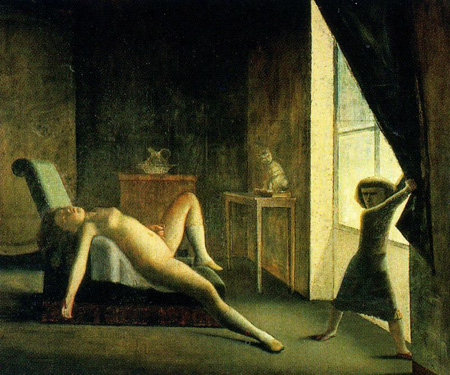
The complexities opened by Balthus's painting within contemporary discourse concerning art is exemplified by works such as The Room (1952-54). Balthus maintained that he did not attempt to make The Room as an erotic representation. When we assess the picture however we cannot but notice that the young woman in the chair may well be enjoying an ecstatic moment. She may also simply be asleep. The possibility of the latter reading retreats somewhat when we realize that the curtain has only now been thrown open by another figure which exposes the girl's languid figure to the light. Still, this remains an ambiguous painting - quintessentially Balthus. Questions jostle into formation in the viewer's mind: Has the young woman been masturbating? (images of auto-arousal are rare in Western oil painting). Has she been the victim of an attacker? (Does the limpness of her right arm imply harm?); Or, has she merely been resting / sleeping near a curtain which is warmed by the sun? If the later is the case then she may be understood as confident in her body and her sexuality as she makes no effort to hide herself as the curtain is thrust open.(read)


The Window (1933)


.
.

towards yearning

The element at bottom is cloth. The element on top was originally two sets of intersecting lines. The combination indicates a long piece of fabric with fine cross-stitches. Scarce and rare are associated meanings, via "fine." Desire is an extended meaning, in the sense of a longstanding desire of a kind rarely obtained.


adds sun/day to suggest the drying out of a cloth by means of exposure to the sun. Thus the meaning dry out.


adds eye to suggest "gaze at a fine, dimly visible object." Yearn for is an associated meaning (yearn for something far off, dimly visible).


..